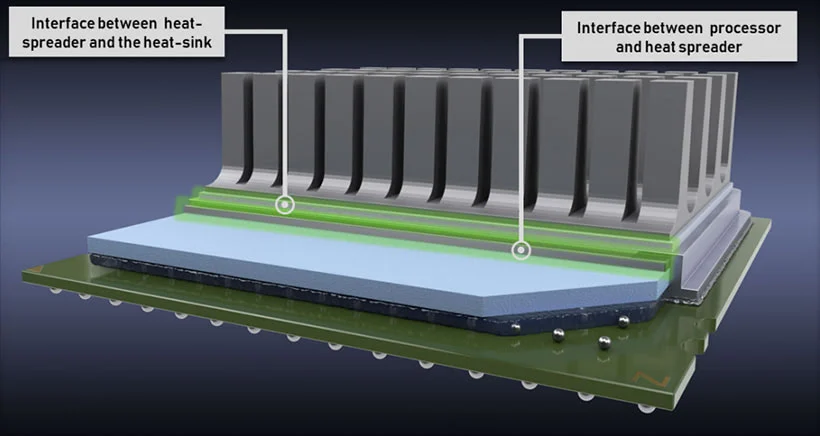
Thermal pad
Thermal Interface
A Thermal Interface refers to the physical contact layer between two surfaces that facilitates efficient heat transfer from one object to another—most often from a heat-generating component (like a CPU, GPU, power transistor, or LED) to a heat sink or cooling device.
Why It’s Needed
When two solid surfaces are placed together (even if they seem smooth), microscopic air gaps form due to surface imperfections. Air is a poor conductor of heat, so these gaps impede thermal flow, causing overheating and performance degradation.

Common Types of Thermal Interface Materials (TIMs)
| Type | Description | Use Case |
|---|---|---|
| Thermal Paste/Grease | Semi-fluid compound, very effective at filling gaps | CPUs, GPUs |
| Thermal Pads | Soft, solid pads that conform to surface irregularities | Power electronics, battery packs |
| Phase Change Materials (PCMs) | Solid at room temp, melt under heat to fill gaps | Servers, high-power ICs |
| Thermal Tapes | Double-sided adhesive with thermal conductivity | LED modules, heatsinks |
| Metallic Interfaces | Thin metal foils or solder | High- performance military /aerospace |
⚙️ Key Properties to Consider
Thermal Conductivity (W/m·K): Higher means better heat flow.
Thickness: Thinner materials typically conduct better, but must still fill all gaps.
Compressibility: Helps conform to uneven surfaces.
Electrical Insulation: Some TIMs are also electrically non-conductive, ideal for sensitive components.
Adhesion: Some TIMs offer mechanical bonding along with thermal performance.
🧊 Applications Across Industries
Consumer Electronics: Laptops, smartphones, gaming consoles.
Data Centers: Servers, cooling systems.
Automotive: Battery thermal management in EVs.
Telecommunications: Power amplifiers and RF modules.
Industrial Equipment: Motor controllers, inverters.
Benefits of Using TIMs
Prevent overheating
Improve system performance and longevity
Ensure safety by controlling surface temperatures
Enable compact designs with higher power densities