LED driver focus
Materials chosen for compact housings, dielectric safety, and repeatable heat dissipation.
LED driver thermal pads, conductive sheets, and electrical insulation materials for reliable heat dissipation in compact lighting electronics. We support 1–6 W/mK conductivity, adhesive options, and custom die-cut shapes for OEM assemblies.
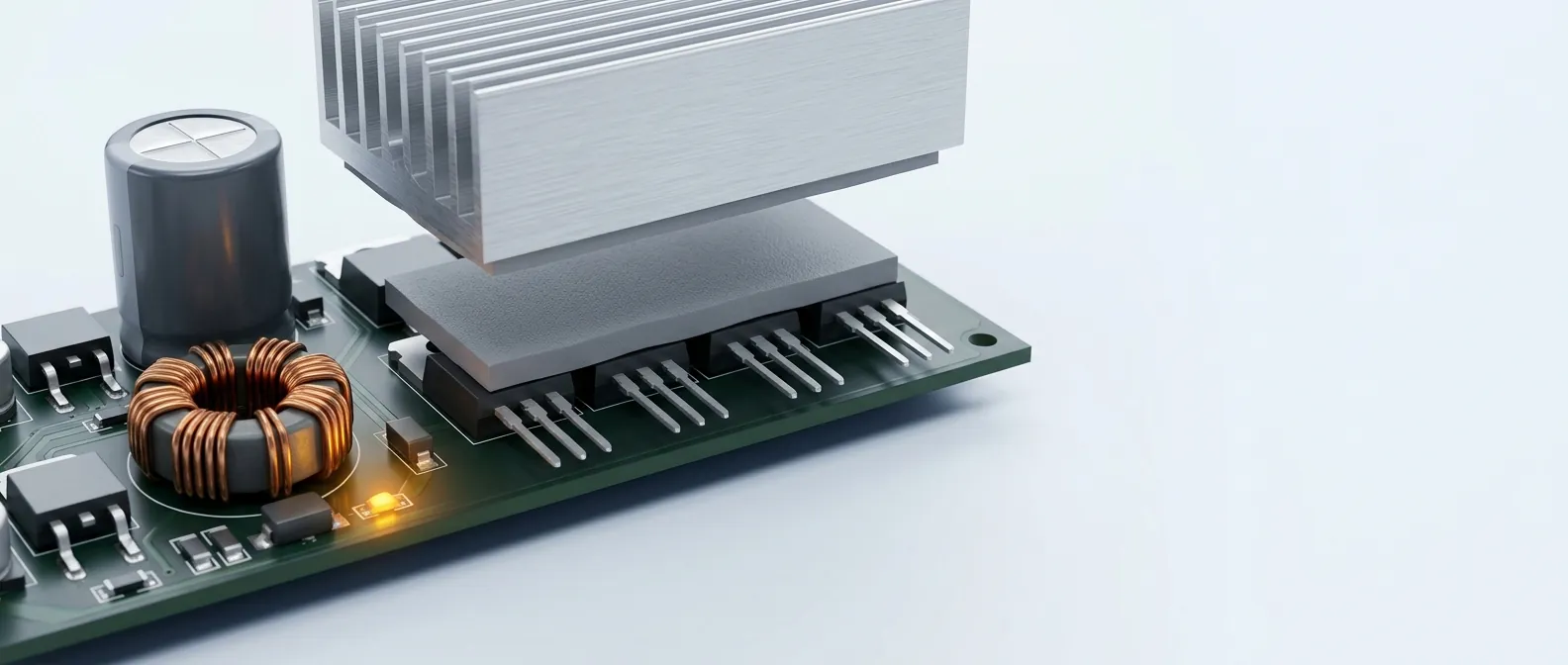
An LED driver is a small switch-mode power supply sealed inside the luminaire. The switching MOSFET, the rectifier stage and the control IC all dump heat into an enclosed housing that has no airflow of its own, and the only way that heat can leave is by conduction: through the component case, into the metal enclosure, and out to ambient air. LED driver boards create localized heat around semiconductors, magnetic parts, and enclosed housings. Poor thermal paths can shorten driver life and create performance drift in lighting systems.
That path fails at its weakest layer. A bare PCB or component tab never sits perfectly flat against the housing, and the air gap that remains — even a fraction of a millimetre — conducts almost nothing. The thermal interface becomes the bottleneck of the entire cooling path, which is why the thermal pad matters more than any other single material choice in the stack-up.
The cost of getting it wrong shows up slowly. Sustained over-temperature shortens the life of the driver's electrolytic capacitors, and capacitor wear-out is what usually ends a driver's service life — long after the luminaire has left the factory. A correctly specified LED driver thermal pad keeps interface resistance low, holds off the voltage between a live tab and a grounded housing, and keeps the driver inside its rated temperature for years.
We supply LED driver thermal pads and electrical insulation materials to your specification — cut, die-cut, and converted for OEM production.
Every watt the switching stage loses has to travel the same road. The junction temperature is whatever the ambient air is, plus the sum of every thermal resistance along that road.
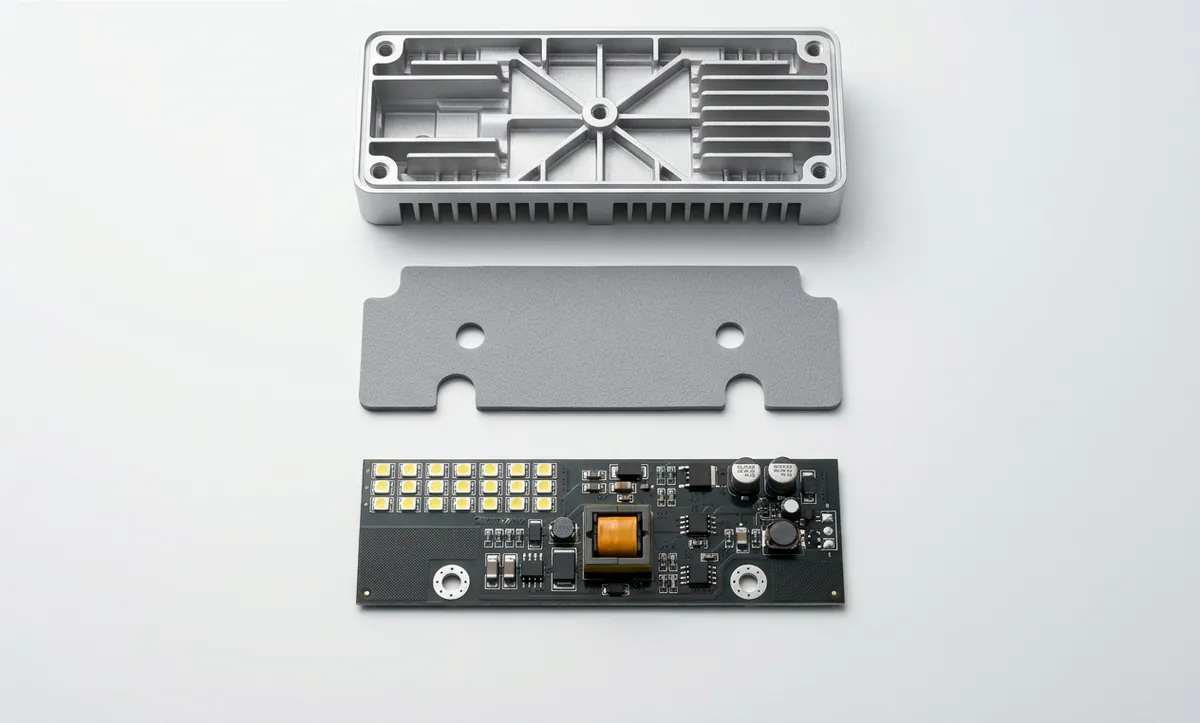
Heat leaves the silicon junction through the package case, crosses the interface into the heatsink or metal housing, and only then reaches ambient air. Most of those layers are fixed before the pad is ever chosen — the die, the package, the enclosure geometry are set by the board and the luminaire design.
The interface is the one layer left open, and it is also the one most often left to an air gap. A silicone thermal pad or LED driver insulation sheet in that gap cuts interface resistance sharply compared with still air, at a material cost of a few cents per driver.
All six grades are supplied as sheet with or without adhesive backing, and every grade can be die-cut to your drawing. Technical datasheets are linked per grade.
| Grade | Conductivity | Dielectric strength | Thickness options | Adhesive | Datasheet |
|---|---|---|---|---|---|
| CP100 | 1.0 W/m·K | 4.0 kV/mm | 0.5 / 1 / 2 / 3 mm | Adhesive or plain | TDS |
| CP150 | 1.5 W/m·K | 4.5 kV/mm | 0.5 / 1 / 2 mm | Adhesive or plain | TDS |
| CP200 | 2.0 W/m·K | 5.0 kV/mm | 0.5 / 1 / 2 / 3 mm | Adhesive or plain | TDS |
| CP300 | 3.0 W/m·K | 6.0 kV/mm | 0.5 / 1 / 2 / 3 mm | Adhesive or plain | TDS |
| CP600 | 6.0 W/m·K | 6.0 kV/mm | 0.5 / 1 / 2 / 3 mm | Adhesive or plain | TDS |
| LED-DRV | 2.0 W/m·K | 5.0 kV/mm | 0.5 / 1 / 2 mm | Adhesive or plain | — |
MOQ 10 sheets · typically dispatched in 7 days.
For the TO-220 and TO-247 power stages common in LED drivers, we supply fibreglass-reinforced silicone insulation pads in standard die-cut sizes with the mounting hole pre-cut, ready for the assembly line.
| Package | Size | Mounting hole |
|---|---|---|
| TO-220 | 13 × 19 mm | 3.5 mm |
| TO-220 | 15 × 20 mm | 3 mm |
| TO-247 | 17 × 22 mm | 3 mm / 3.5 mm |
Available fibreglass-reinforced grades: SC 30 (1.0 W/m·K, 0.30 mm), SC 45 (1.0 W/m·K, 0.45 mm), PCV 160S (1.6 W/m·K, 0.23 mm), TC-20TAG-2 (2.0 W/m·K, 0.20 mm) and PCV 200S (2.0 W/m·K, 0.25 mm). Full specifications are on the fibreglass-reinforced range. MOQ for die-cut TO shapes is 50 pieces; custom profiles are quoted against a DXF or PDF drawing.
Grades most often specified for LED driver assemblies, drawn from the live catalogue.
Materials chosen for compact housings, dielectric safety, and repeatable heat dissipation.
Die-cut parts for LED boards, housings, power supply modules, and mounting hardware.
Reliable bulk supply for lighting OEMs, contract manufacturers, and retrofit programs.
Six silicone grades: CP100 (1.0 W/m·K), CP150 (1.5 W/m·K), CP200 (2.0 W/m·K), LED-DRV (2.0 W/m·K), CP300 (3.0 W/m·K) and CP600 (6.0 W/m·K), with dielectric strengths from 4.0 to 6.0 kV/mm. Specifications for each are in the table above.
0.5, 1, 2 and 3 mm for CP100, CP200, CP300 and CP600; 0.5, 1 and 2 mm for CP150 and LED-DRV. Every grade is supplied with or without adhesive backing.
Yes. They are thermally conductive and electrically insulating. Each grade carries a rated dielectric strength, from 4.0 kV/mm (CP100) to 6.0 kV/mm (CP300 and CP600).
Yes. Fibreglass-reinforced silicone pads are held as stock die-cuts for TO-220 (13 × 19 mm and 15 × 20 mm) and TO-247 (17 × 22 mm), with the mounting hole pre-cut, in five grades from 1.0 to 2.0 W/m·K. MOQ is 50 pieces.
Yes. Steel-rule die cutting is done in-house in Bengaluru. Send a DXF or PDF drawing, or a sample part, with the grade, thickness and quantity, and we quote against it.
Standard sheet grades start at 10 sheets and die-cut TO-package shapes at 50 pieces. Catalogue grades are typically dispatched within 7 days. Parts to a new drawing are quoted per job; die cost is one-time.
Send your specification — grade, thickness, size or die-cut drawing, and quantity — and our team will quote to your requirement.